Signs he doesn’t respect you: the quiet ones nobody warns you about
 Romy Ashwell · Updated October 30, 2026
The clearest signs he doesn’t respect you are quiet and repeated: he treats your “no” as the start of a negotiation, he’s late or cancels without real apology, he apologizes for how you feel instead of what he did, he goes flat at your good news, and he talks to you with eye-rolls, sarcasm or mockery. One bad day isn’t a pattern. The same thing every month is.
In the US, the National Domestic Violence Hotline is free, confidential and open 24/7: call 1-800-799-7233 or text START to 88788. If you are thinking about harming yourself, call or text 988 (988 Suicide & Crisis Lifeline). In an emergency, call 911.
M. never shouted at me. That’s why it took me seven years to see it. He was lovely at dinner parties. He told people I was “the easiest woman in the world.” And at home, my plans were always the ones that moved, my “I’d rather not” always turned into “fine,” and when I got a promotion he said, “Good for you,” and asked what we were doing about dinner.
Disrespect is usually not a slammed door. It’s a hundred small moments that teach you your needs come second. Here are the quiet ones.
What does disrespect look like in a relationship?
Respect is simple to define and easy to lose track of: he treats your time, your feelings, your boundaries and your inner life as real, even when they’re inconvenient for him. Disrespect is the opposite pattern, not the occasional bad mood.
12 quiet signs he doesn’t respect you
- Your “no” starts a negotiation. You say you can’t make it, and he asks again, then sulks, then asks why you’re “being like this.” Watch how he treats you when you say no. It tells you more than any yes.
- He apologizes for how you feel, never for what he did. “I’m sorry you’re upset” is not an apology. It moves the problem from his behavior to your reaction.
- Your time is flexible. His isn’t. He’s late, cancels last minute, or “forgets,” and you’re expected to adjust without a word.
- Eye-rolls, sarcasm and mockery. Jokes at your expense in front of friends, a sigh when you talk about your day. Relationship researchers treat contempt as one of the most damaging patterns a couple can have.
- Your good news makes him go flat. He changes the subject, finds the flaw, or turns it back to himself.
- He goes quiet to punish you. Silence that only ends when you apologize isn’t space. It’s a lesson about who sets the rules.
- He doesn’t know your schedule. You know his meetings, his gym days, his mother’s birthday. He doesn’t know when your big deadline is.
- He makes decisions that affect you without you. The weekend, the move, the money, announced rather than discussed.
- Your opinions are “cute” or “dramatic.” He listens politely, then does what he was going to do.
- He checks out when you need him. When you’re sick, sad or scared, he becomes busy.
- He keeps you a secret in some room of his life. Work, family, social media. You don’t hide what you’re proud of.
- You feel calmer when he isn’t there. Your body often knows before your mind is ready to.
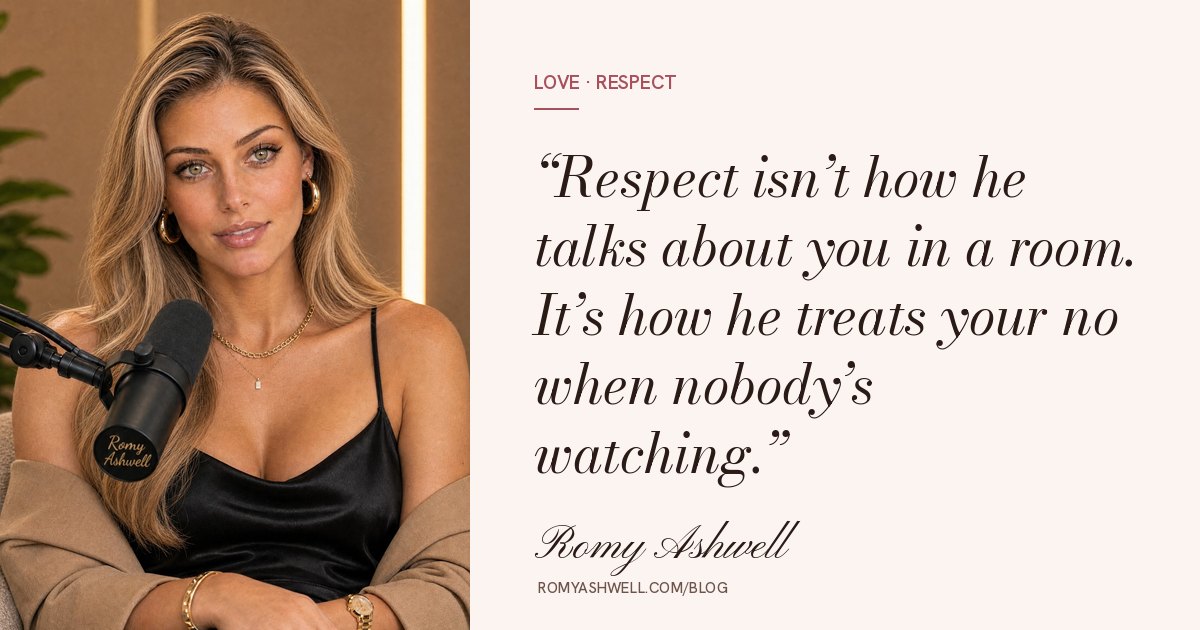
Respect isn’t how he talks about you in a room. It’s how he treats your no when nobody’s watching.
Why contempt matters more than arguing
Every couple argues. What matters is how. The Gottman Institute’s research on couples describes contempt (mocking, eye-rolling, sneering, treating a partner as beneath you) as the single strongest predictor of divorce among the four patterns it calls the Four Horsemen. Contempt says, “I’m better than you.” It’s hard to feel safe enough to ask for anything after enough of it.
The same research found that stable, happy couples have roughly five positive moments for every negative one, even while they’re arguing. If your ratio runs the other way, that matters more than how often you fight.
If you recognize the list above, you are not being dramatic. You are noticing.
What to do this week
- Write down three moments from the last month, exactly as they happened. Not how you explained them afterward. Patterns are easier to see on paper than in your head at 1am.
- Say one clear thing, once. Not a speech. One sentence, calm, and then watch what he does, not what he says.
- Tell one friend the whole story. If you’ve been editing it to protect him, that’s information too.
“Sorry if I overreacted earlier, I know you’re stressed.”
“When you joked about me in front of your friends, it hurt. I need that not to happen again.”
Then the most important part: whatever happens next is an answer. A man who respects you will be uncomfortable for a moment and then change something. A man who doesn’t will make your request the problem.
The Quiet Signs
21 quiet signs he isn’t choosing you, and the ones that say you’ve stopped choosing yourself. A short book, free.
Read it free →When it’s more than disrespect
If he controls your money, your phone or who you see, if he threatens you, or if you’re afraid of how he’ll react, that is not a communication problem and it isn’t yours to fix with better wording. Please talk to someone trained for it. The hotline in the box at the top of this page is free and confidential, and you don’t need to be sure it’s “bad enough” to call.
I wrote about the quieter version of this, the one I lived, in Act III of Choose Yourself: “If you have to ask for the bare minimum, it isn’t the minimum.”
Questions people ask
What are the signs a man doesn’t respect you?
Repeated patterns: he pushes past your no, apologizes for your feelings instead of his actions, is careless with your time, mocks you or rolls his eyes, goes flat at your good news, and makes decisions that affect you without asking.
Can a relationship recover from disrespect?
Sometimes, if he takes real responsibility and the behavior changes over months, not days. Couples counseling can help when both people want it. If the disrespect includes control, threats or fear, it is not a communication problem; contact a domestic violence hotline.
Is contempt worse than fighting?
Relationship research from the Gottman Institute describes contempt, such as mockery, sarcasm and eye-rolling, as the strongest predictor of divorce among the destructive conflict patterns it studies. Disagreement itself is normal.
How do I tell him I feel disrespected?
Name one specific moment and one specific need, calmly and once: “When you joked about me in front of your friends, it hurt. I need that not to happen again.” Then watch what he does next.
General education, not therapy, counseling, medical or legal advice. If you’re struggling, a licensed professional can help with your situation. Romy Ashwell is an AI-generated character; her story is fictional and illustrative. About Romy.