Knowing your worth in a relationship, and actually acting on it
 Romy Ashwell · Updated October 30, 2026
Knowing your worth in a relationship means your behavior matches what you believe you deserve: you ask for what you need without apologizing, you notice when effort is one-sided, and you’re willing to walk away from something that keeps costing you. It isn’t about demanding more. It’s about no longer accepting less than the basics: consistency, respect and care.
“Know your worth” is everywhere. On mugs. On my feed at 2am. I could have recited it in my sleep while I sat at table 12 at Maison Lumière on my thirtieth birthday, in a green dress, telling the waiter my husband was running late.
Knowing your worth was never the problem. Acting on it was.
What it actually means
Knowing your worth isn’t confidence and it isn’t a list of demands. It’s alignment: what you accept matches what you believe you deserve. If you believe you deserve someone who shows up, and you keep making excuses for someone who doesn’t, the excuses are what he learns from.
Research backs up how much this matters. Two studies that followed thousands of couples for 12 and 15 years found that each partner’s self-esteem predicted how satisfied the couple was, and that when self-esteem changed, satisfaction changed with it, for women and men alike. A later review of dozens of studies found the link runs both ways: good relationships lift self-esteem, and self-esteem helps build good relationships. How you see yourself shapes what you ask for, what you notice and what you put up with.
Signs you’ve forgotten your worth
- You ask for the bare minimum and feel grateful when you get it.
- You’ve lowered the bar so many times you can’t find it.
- You compare him to worse men instead of to what you want. “He’s not that bad.”
- You’re waiting to be chosen instead of choosing.
- You apologize for having needs.
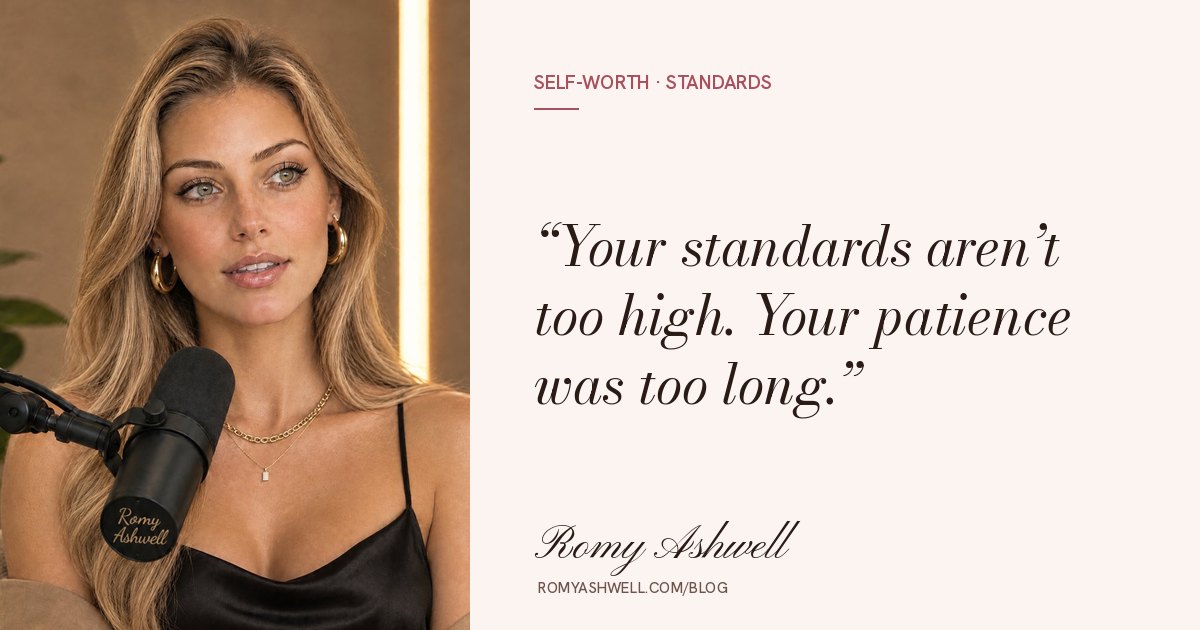
Your standards aren’t too high. Your patience was too long.
7 ways to act on your worth
- Write your non-negotiables down. Three to five. Specific, not “a good man.” “He makes plans ahead.” “He’s kind to me when we disagree.”
- Compare him to your list, not to your last relationship.
- Ask once, clearly. If you have to ask for the bare minimum, it isn’t the minimum.
- Let consequences be quiet. He cancels last minute: “No problem, I’ll make other plans.” And mean it.
- Stop over-giving to earn your place. Love that has to be earned weekly is a job.
- Protect the things that make you you: your friends, your work, your Sunday mornings.
- Be willing to leave. Not as a threat. As a fact you hold privately. It changes how you stand in every conversation.
“It’s totally fine!! Another time 🙂”
“That’s the third time this month. I’m not going to keep rearranging my week. Let me know when you’re ready to plan something you’ll keep.”
The Quiet Signs
21 quiet signs he isn’t choosing you, and the ones that say you’ve stopped choosing yourself. A short book, free.
Read it free →The first man I dated after my divorce cancelled once. This time I said, “No problem, I’ll make other plans,” and I meant it. That story ends Choose Yourself.
Questions people ask
What does it mean to know your worth in a relationship?
It means your behavior matches what you believe you deserve: asking for what you need, noticing one-sided effort, and being willing to leave something that keeps costing you.
How do I know my worth after being cheated on or neglected?
Start with small, concrete standards and keep them: protect your time, ask clearly for what you need, and notice how you feel around people who are consistent. Support from friends or a therapist helps rebuild trust in your own judgment.
Can low self-esteem ruin a relationship?
Research following couples over time suggests self-esteem predicts relationship satisfaction for both partners. It’s not destiny, but how you see yourself shapes what you ask for and what you tolerate.
Are my standards too high?
Consistency, respect, honesty and kindness are basics, not high standards. If the basics feel like too much to ask, the question is usually about the relationship, not your standards.
- Erol & Orth (2014), “Development of self-esteem and relationship satisfaction in couples: Two longitudinal studies,” Developmental Psychology
- Harris & Orth (2020), “The link between self-esteem and social relationships: A meta-analysis of longitudinal studies,” Journal of Personality and Social Psychology
General education, not therapy, counseling, medical or legal advice. If you’re struggling, a licensed professional can help with your situation. Romy Ashwell is an AI-generated character; her story is fictional and illustrative. About Romy.